
Teen Patti Game Guide: Rules, Gameplay and Tips for Beginners
A Teen Patti Game Guide is the easiest place to start if you are new to this popular three-card game and want to understand what actually happens at the table.
Teen Patti may look simple because every player receives only three cards, but beginners still need to understand hand rankings, Blind and Seen play, Chaal, Pack, Show, and the basic flow of a round. Online versions can add another layer because the app automatically handles cards, turns, balances, and table controls.
This guide explains Teen Patti in simple language so you can understand the game before exploring a Teen Patti table inside a multi-game platform such as 3 Patti No 1. For a detailed independent explanation of the traditional rules, you can use Pagat as an external reference.
The basic objective is straightforward: remain in the round with a strong three-card hand or become the final active player after others leave the hand. The exact betting rules and special features can vary between physical games and online tables, so always check the rules displayed by the specific game you are using.

Teen Patti Game Guide: How a Round Begins
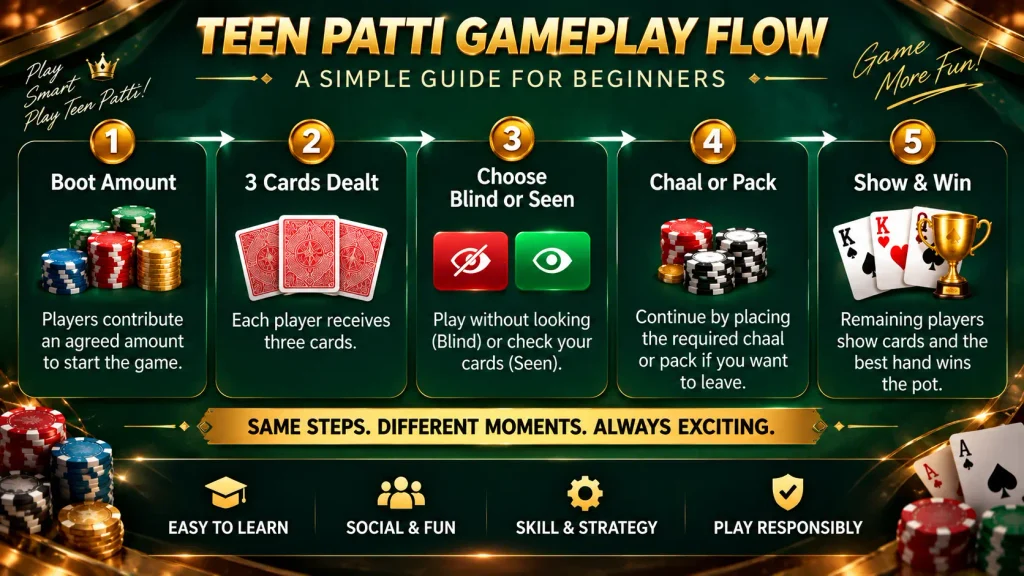
A normal Teen Patti round starts with the players contributing an initial amount to the central pot. This starting contribution is commonly called the boot.
After the pot is created, each player receives three cards face down.
Players then take turns deciding whether to continue or leave the round. Traditional rules allow players to remain Blind without checking their cards or become Seen after viewing them.
In an online game, these actions are usually represented by clearly labeled buttons on the screen.
Understanding Blind and Seen
Blind and Seen are two of the most important terms in any Teen Patti Game Guide.
- A Blind player has not looked at the three cards. The cards remain unknown to that player while the round continues.
- A Seen player has checked the cards and therefore knows the strength of the current hand.
Online tables normally make this distinction through interface controls. The precise contribution rules for Blind and Seen players can differ according to the table, variation, or app, so beginners should not assume that every Teen Patti table uses identical limits. Pagat’s traditional rules, for example, describe different stake requirements for Blind and Seen players.
What Do Chaal, Pack and Show Mean?
- Chaal generally refers to continuing in the round by placing the required contribution after viewing your cards.
- Pack means leaving the current hand. Once a player packs or folds, that player normally takes no further part in that round.
- Show refers to comparing the remaining players’ cards when the applicable rules allow it. The stronger hand wins according to the Teen Patti hand-ranking system.
Some versions also offer a Side Show or similar feature. Because these rules can differ by table, always read the individual game instructions before using the option.
Teen Patti Hand Rankings for Beginners
Learning the hand rankings is one of the most important parts of this Teen Patti Game Guide.
The commonly used order from strongest to weakest is:

| Rank | Hand | Simple Explanation |
|---|---|---|
| 1 | Trail / Trio | Three cards of the same rank |
| 2 | Pure Sequence | Three consecutive cards of the same suit |
| 3 | Sequence | Three consecutive cards of mixed suits |
| 4 | Color / Flush | Three cards of the same suit, not consecutive |
| 5 | Pair | Two cards of the same rank |
| 6 | High Card | None of the combinations above |
This general ranking order is documented by multiple Teen Patti rules references, including Pagat and contemporary beginner guides.
For example, three matching cards form a Trail or Trio. A Pure Sequence contains three consecutive cards belonging to the same suit, while a regular Sequence uses consecutive cards that are not all from the same suit.
A Pair contains two cards of the same rank. If no player has any of these combinations, the hand may be compared using the highest card according to the applicable rules.
How Online Teen Patti Gameplay Works
In online Teen Patti, software handles many actions that players would manage manually in a traditional game.
The app can distribute digital cards, display the pot, manage turns, show table limits, and provide action buttons such as Blind, Seen, Chaal, Pack, and Show.
This automation makes the interface easier to follow once you understand the terminology.
However, online platforms may also contain several different games. A lobby can include Teen Patti alongside games such as Rummy, Poker-style games, Dragon vs Tiger, Crash-style games, board games, or other categories depending on the platform and version.
This is why beginners should check the name of the game before entering a table rather than assuming every section of a multi-game app follows Teen Patti rules.
7 Beginner Tips for Understanding Teen Patti
The first tip is to learn the hand rankings before playing. If you cannot quickly distinguish a Pair from a Sequence or a Color from a Pure Sequence, the rest of the game becomes difficult to follow.
Second, learn what every button does before joining an active table. Blind, Seen, Chaal, Pack, Show, and Side Show should not be learned by trial and error during a live round.
Third, check the table rules. Teen Patti has variations, and some apps may change limits, betting requirements, or special features.
Fourth, do not assume that receiving a high card automatically means you hold a strong hand. Hand categories come before individual card values.
Fifth, take time to understand the interface. Online play can move quickly because dealing and calculations are automated.
Sixth, if money is involved, decide your spending and time limits before starting rather than during the game.
Seventh, do not treat Teen Patti as guaranteed income. Cards involve chance, and no system or strategy can guarantee winning outcomes.
Traditional Teen Patti vs Online Teen Patti
Traditional Teen Patti uses physical cards and usually involves players sitting together in the same location.
Online Teen Patti moves the same basic three-card concept to a digital interface.
The online version can automatically deal cards, calculate the pot, display player turns, and connect participants remotely.
Traditional play offers more face-to-face interaction, while online play emphasizes convenience and automation.
The rules can be similar, but digital platforms may introduce additional modes and table-specific features. That is why this Teen Patti Game Guide focuses on the core principles rather than claiming that every app works exactly the same way.
Common Beginner Mistakes
One common mistake is entering a game without knowing the hand-ranking order.
Another is confusing Blind with Seen play or assuming that the required contribution will always be identical.
Beginners can also misunderstand Pack and Show, especially when moving from a physical game to an online interface.
A more serious mistake is believing that previous losses make a future win more likely. Each game still involves uncertainty, and chasing previous losses can increase financial harm.
GamCare recommends setting limits on both time and money and only spending what you can afford when gambling.
Stay Safe When Using a Gaming App
Online gaming also introduces account and device-security considerations.
Before installing any Android gaming application, check the source and review the permissions it requests. Avoid sharing passwords, PINs, verification codes, or banking credentials.
Google states that Play Protect checks apps for potentially harmful behavior, including applications installed from sources outside Google Play, and can warn users or block harmful installations. Google recommends using Google Play Protect to help detect potentially harmful applications.
Keeping device security features enabled is particularly important when an app handles account or payment information.
Why Beginners Should Learn the Rules First
An attractive interface can make Teen Patti appear easier than it really is. Learning the basic rules first helps you understand why a hand wins, what each button means, and how the round progresses. Once you understand the core rules, you can explore different tables and variations more confidently without confusing one mode with another. This is the main purpose of a Teen Patti Game Guide: helping beginners understand the mechanics before they interact with a game.



This Teen Patti Game Guide gives beginners the foundation they need to understand the game: three-card hands, Blind and Seen play, Chaal, Pack, Show, and the standard hand-ranking order. Start by learning the rankings. Then understand the table controls and read the rules of the specific version you want to explore.
If you are using an online app, pay attention to account security and device permissions as well. If real money is involved, set firm time and spending limits and treat the game as entertainment rather than guaranteed income.