
3 Patti Online vs Traditional Teen Patti: What’s the Difference?
Online Teen Patti vs Traditional Teen Patti is an interesting comparison because both versions are based on the same three-card game, yet the playing experience can feel completely different.
Traditional Teen Patti is normally played face-to-face with physical cards, a dealer, and a group of people sitting around the same table. Online Teen Patti moves that experience to a digital platform where card dealing, turn management, pot calculation, and player matching can be handled automatically.
The core principles may remain familiar, but the interface, speed, social experience, convenience, security considerations, and available game modes can differ significantly.
If you are new to 3 Patti, this guide explains the major differences between the online and traditional versions so you can understand how each format works.
What Is Traditional Teen Patti?
Traditional Teen Patti is a three-card game usually played with a standard 52-card deck.
Players contribute an agreed starting amount to the pot and receive three cards each. Players may choose to remain blind or look at their cards and continue as seen players.
The hand-ranking system typically includes Trail or Trio, Pure Sequence, Sequence, Color, Pair, and High Card.
According to Pagat’s detailed Teen Patti rules, the traditional game uses a standard 52-card pack, gives each player three cards, and allows players to participate either blind or seen.
Click for read more, Teen Patti Rules – Pagat
Traditional Teen Patti is often a highly social experience because players can talk, observe each other, and interact directly throughout the game.
What Is Online Teen Patti?
Online Teen Patti converts the traditional card-table experience into a digital format.
Instead of physically shuffling and dealing cards, the software handles these processes. The application can also manage betting calculations, turns, table limits, and game results.
Modern digital versions may add private rooms, tournaments, different table limits, special variations, rewards, and additional game categories.
The underlying three-card concept may therefore remain familiar while the surrounding experience becomes much more automated.
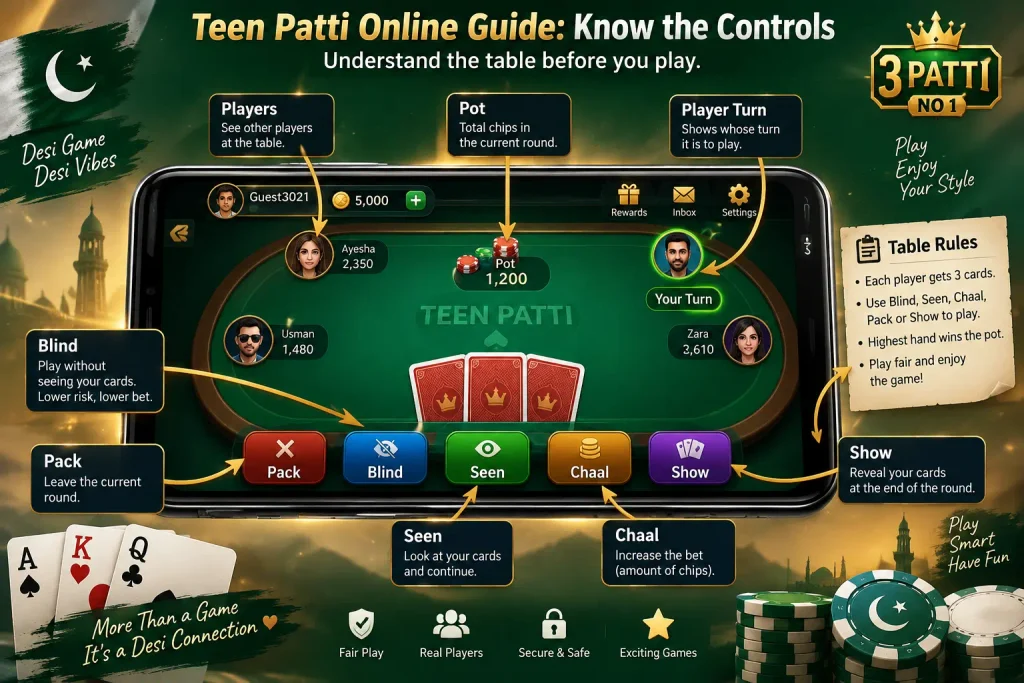
Online Teen Patti vs Traditional Teen Patti: Quick Comparison
| Feature | Online Teen Patti | Traditional Teen Patti |
|---|---|---|
| Cards | Digital cards | Physical cards |
| Dealer | Automated software | Human dealer |
| Location | Can be played remotely | Players usually meet physically |
| Game speed | Generally faster | Usually slower |
| Player matching | Automated | Players organize their own group |
| Social interaction | Chat, emojis, digital interaction | Face-to-face conversation |
| Game calculations | Automatic | Players manage them manually |
| Game variations | Often multiple digital modes | Usually depends on group rules |
| Device required | Smartphone/tablet/computer | No device required |
| Internet required | Usually yes | No |
| Physical tells | Limited | More visible |
| Security concerns | Account/app/device security | Physical game management |

1. Physical Cards vs Digital Interface
The clearest difference between Online Teen Patti vs Traditional Teen Patti is the way the game is presented.
Traditional Teen Patti uses physical cards.
Someone must shuffle the deck, deal the cards, manage the pot, and make sure players follow the agreed rules.
Online Teen Patti performs many of these tasks digitally.
Players see their cards and available actions directly on a screen. Buttons may include options such as Blind, Seen, Chaal, Pack, or Show.
For beginners, a digital interface can make certain parts of the game easier to follow because available actions are displayed on-screen.
However, players should still understand what each control means before joining a game.
2. Online Teen Patti Is Usually Faster
Traditional Teen Patti requires time for shuffling, dealing, collecting chips, counting the pot, and resolving disputes.
Online games can automate these tasks.
Cards may be dealt almost instantly, turns can have timers, and pot calculations happen automatically.
As a result, online rounds can move considerably faster.
That speed can be convenient, but players should avoid making rushed decisions simply because the interface encourages faster gameplay.
Understanding the rules remains more important than playing quickly.
3. Social Experience Is Very Different
Traditional Teen Patti is strongly associated with in-person interaction.
Players can talk, joke, watch reactions, and observe body language.
That social environment is one reason physical card games remain popular.
Online Teen Patti changes this experience.
Players might communicate through text chat, emojis, profile pictures, or other digital features, but they generally cannot observe the same physical reactions they would see around a real table.
This changes the psychological side of the game.
Instead of watching facial expressions or gestures, online players interact primarily through the digital table.
4. Accessibility and Convenience
Traditional Teen Patti requires several people to be available in the same location.
You need cards, a suitable place to play, and enough participants.
Online Teen Patti removes much of this logistical requirement.
A user can access an online table from a compatible device when players are available through the platform.
This convenience is one of the biggest differences in Online Teen Patti vs Traditional Teen Patti.
However, online access also means users need a stable internet connection and a compatible device.
5. Game Variety Can Be Much Larger Online
A physical Teen Patti session usually focuses on Teen Patti itself or variations agreed upon by the group.
Online platforms can contain many additional formats.
A multi-game interface such as 3 Patti No 1 may display different categories instead of offering only one classic Teen Patti table.
Depending on the current app version, users may encounter card games, board-style games, fast games, or other categories.
Digital Teen Patti platforms can also include variations such as Joker modes, Muflis, or other table-specific formats. Current Teen Patti guides note that online apps may introduce special modes and modified table rules, so users should always check the particular game’s instructions.
This is why a new player should never assume every icon inside a gaming app follows standard Teen Patti rules.

6. Human Dealer vs Automated Game System
Traditional Teen Patti relies on players or a designated dealer.
The dealer physically handles the deck.
Online Teen Patti uses software to distribute digital cards and manage the round.
This means users do not physically see the cards being shuffled.
Instead, they depend on the platform’s game system.
For this reason, users should carefully evaluate any platform they choose to use, particularly when money or personal information is involved.
Avoid assuming that an unfamiliar application is trustworthy simply because its interface looks professional.
7. Security Risks Are Different
Traditional Teen Patti does not require installing software or creating an online account.
Online Teen Patti introduces additional digital-security considerations. Users may need to create an account, install an app, allow certain permissions, or use payment services depending on the platform.
Google explains that Google Play Protect checks apps and Android devices for potentially harmful behavior, including apps installed from sources outside the Google Play Store. It can also warn users about suspicious apps or block potentially harmful installations.
For more information, read Google’s official guide here:
Google Play Protect – Keep Your Apps Safe and Your Data Private
If you install an Android gaming app or APK, always check its source and review the permissions it requests before giving it access to personal information.
Never share your passwords, PINs, verification codes, wallet credentials, or banking information with another person.

Do the Teen Patti Hand Rankings Change Online?
Usually, the familiar hand structure remains recognizable.
Common hand categories include:
- Trail or Triom: Three cards of the same rank. Example: K-K-K.
- Pure Sequence: Three consecutive cards of the same suit.
- Sequence: Three consecutive cards that are not all from the same suit.
- Color: Three cards belonging to the same suit without forming a sequence.
- Pair: Two cards of the same rank.
- High Card: A hand that does not form any of the combinations above.
Pagat documents this general ranking structure for traditional Teen Patti. However, specific online variations can modify normal rules. Always read the table instructions rather than assuming every digital mode follows exactly the same ranking system.
Blind and Seen: Online vs Traditional
Blind and Seen are important parts of Teen Patti.
A Blind player continues without checking the three cards.
A Seen player has looked at the cards.
In traditional Teen Patti, players physically keep their cards face down or look at them privately.
Online, the game interface handles this distinction.
Selecting the appropriate button tells the software whether you want to continue Blind or view the cards.
The concept is similar, but the interaction method is different.

Is One Version Easier to Learn?
Both versions can teach the fundamentals.
Traditional Teen Patti gives beginners a physical understanding of the cards, table, players, and flow of the game.
Online Teen Patti may make the process visually simpler because the application automatically handles dealing, calculations, and turn order.
However, automation can also hide some of the mechanics from a beginner.
The best approach is to understand the traditional rules first and then learn how a particular online interface represents those rules.
Online Teen Patti and App Safety
One important difference is that traditional play does not require downloading an APK.
Online gaming may require software installation.
Before installing any APK:
- Check the source.
- Review requested permissions.
- Keep Android security features active.
- Avoid modified or unofficial files from unknown sources.
- Use unique passwords.
- Do not provide unnecessary personal or financial information.
Google recommends keeping Play Protect enabled because it checks installed applications and can identify potentially harmful behavior.

Responsible Gaming Applies to Both Versions
Whether Teen Patti is played online or around a physical table, gambling can involve financial risk.
Do not treat the game as guaranteed income.
No strategy can guarantee that a player will win.
If real money is involved, set clear spending and time limits before playing.
Do not use money needed for rent, bills, food, education, or other essentials.
Avoid chasing losses by increasing the amount you play simply to recover money already lost.
These principles apply regardless of whether the cards are physical or digital.
Which Experience Is More Social?
Traditional Teen Patti provides stronger face-to-face interaction.
Friends or family can sit together, talk, and react to each hand.
Online Teen Patti provides greater geographical flexibility because participants do not necessarily need to be in the same room.
So the difference is not simply “old versus new.”
Traditional Teen Patti emphasizes the physical social experience.
Online Teen Patti emphasizes accessibility, automation, speed, and digital features.
Final Thoughts
The Online Teen Patti vs Traditional Teen Patti comparison shows that both formats come from the same basic three-card game but deliver very different experiences.
Traditional Teen Patti offers physical cards, face-to-face interaction, and a more social table environment.
Online Teen Patti provides digital convenience, faster rounds, automated calculations, remote player matching, and potentially more game variations.
Neither format changes one fundamental point: players should understand the rules before participating.
Learn the hand rankings, understand Blind and Seen play, check the rules of each variation, protect your account and device when playing online, and treat any real-money gaming as entertainment with financial risk.