
3 Patti No 1 Guide for New Players: 11 Powerful Tips
3 Patti No 1 Guide for New Players is designed to help beginners understand the most important playing habits, card rankings, table choices, and safety practices before they start playing regularly.
Teen Patti may look simple because each player receives only three cards, but good decisions still depend on understanding the hand rankings, table situation, playing style, and personal limits.
New players often focus too much on winning individual rounds. A better approach is to learn the game gradually, observe what happens at the table, and avoid unnecessary risks.
This 3 Patti No 1 Guide for New Players explains practical tips that can help beginners improve their overall experience and develop better playing habits.
Learn Card Rankings Before You Start
The first step for every beginner is learning the basic Teen Patti hand rankings. If you do not understand which combinations are stronger, it becomes difficult to decide whether you should continue, raise, or fold.
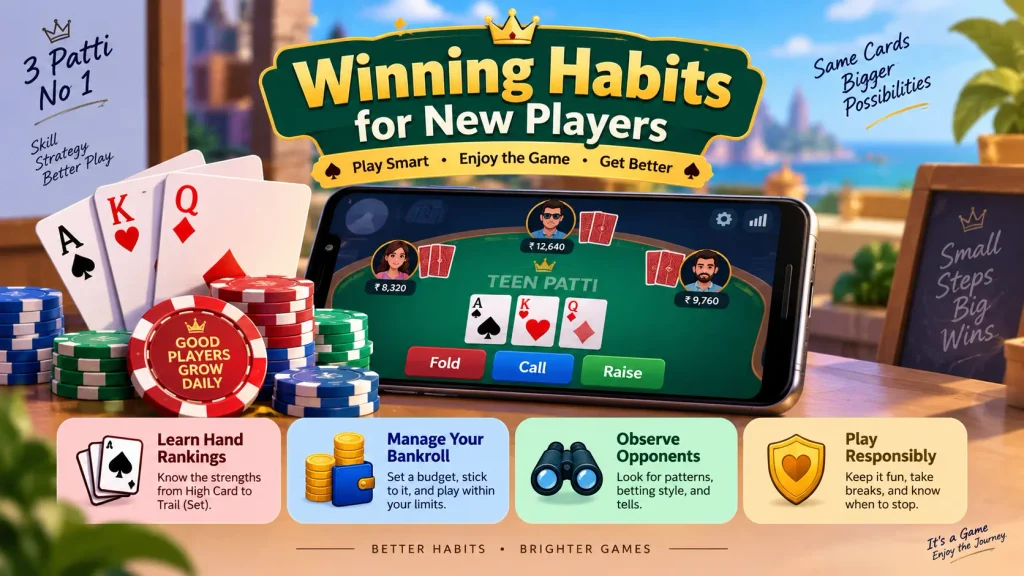
Common Teen Patti Hand Rankings
- Trail or Trio: Three cards of the same rank form a Trail or Trio. For example, three Kings or three Queens. This is generally one of the strongest combinations in Teen Patti.
- Pure Sequence: A Pure Sequence includes three consecutive cards from the same suit. For example, 5, 6, and 7 of Hearts.
- Sequence: A Sequence also contains three consecutive cards, but they do not all belong to the same suit.
- Color: Three cards of the same suit that are not in sequence are usually called a Color.
- Pair: A Pair includes two cards of the same rank. For example, two 9s with one additional card.
- High Card: If your cards do not form any stronger combination, the highest card normally determines the strength of your hand.
Understanding these rankings makes it easier to evaluate your cards quickly. This is one of the most important lessons in any 3 Patti No 1 Guide for New Players.
For a broader overview of Teen Patti rules and hand rankings, you can read more on Wikipedia.
Begin With Small Tables
Many new players are attracted to high-value tables because they appear more exciting. However, beginners should usually start with smaller tables. Small tables provide an opportunity to understand how the game works without placing too much of your available balance into individual rounds.
During your first sessions, pay attention to:
- Blind and seen options
- Table limits
- Raise amounts
- Fold options
- Player behavior
- Round timing
Do not rush into higher-value tables simply because other players are doing so. The goal in the beginning should be learning. Once you are comfortable with the basic controls and table flow, you can make more informed decisions about where you want to play.

Understand Blind and Seen Play
Blind and seen play are important parts of Teen Patti. A blind player continues without looking at the cards. A seen player checks the cards before making a decision. Both options create different situations. Blind play can make the game more unpredictable because you are acting with limited information. Seen play gives you more information about your hand and may feel easier for beginners.
This 3 Patti No 1 Guide for New Players recommends learning how both options work before trying to use them strategically. Do not copy another player simply because they are playing blind. Choose the option that matches your understanding, budget, and comfort level.
Set a Budget Before Playing
Bankroll management is one of the most useful habits a player can develop. Before opening a table, decide how much money or in-game balance you are prepared to use.
Once you reach that limit, stop. Do not keep increasing your budget because you lost previous rounds. Trying to recover losses quickly can lead to poor decisions. A simple budget system can help.
For example, instead of using your full available balance in one session, divide it into several smaller sessions.
This allows you to control how much you use at one time.
Never use money that is meant for:
- Rent
- Bills
- Food
- Education
- Savings
- Medical expenses
Responsible bankroll management should remain an important part of your playing routine.
Observe Other Players
Good players do not only look at their own cards. They also watch the table. Pay attention to how other players behave.
For example:
- Does someone raise frequently?
- Does a particular player fold very quickly?
- Does someone usually play blind?
- Does a player suddenly become aggressive?
These patterns do not guarantee what cards a player holds, but observation can still improve your decision-making. Over time, you may begin to recognize common playing styles. Some players are aggressive. Others are cautious. Some change their style frequently. Observation is one of the simplest skills covered in this 3 Patti No 1 Guide for New Players, and it can make your sessions more structured.
Do Not Play Every Hand Aggressively
New players sometimes believe they need to stay active in every round. That is not necessary.
Sometimes folding is the better decision. If you have a weak hand and other players are raising aggressively, continuing automatically may not be the smartest choice. Good players understand that protecting their balance can be more important than participating in every hand.
Do not think of folding as failure. Folding is simply another decision available to you. The important thing is to evaluate each round independently. Avoid making aggressive moves just because you want more action. Patience is an important part of Teen Patti.
Avoid Emotional Playing
One of the biggest mistakes beginners make is allowing emotions to control their decisions. After losing several rounds, a player may begin increasing stakes.
They may think:
- “I just need one big win.”
This mindset can create unnecessary risk. Every round is different. Previous losses do not guarantee that the next hand will be better. If you feel frustrated, angry, tired, or impatient, take a break. Do not continue simply because you want to recover previous losses.
The 3 Patti No 1 Guide for New Players approach is simple: Make decisions based on the current situation, not emotion. A short break can help you return with a clearer mindset.
Protect Your Account and Device
Account security is just as important as playing strategy. Use a strong password. Avoid using the same password that you use for email, banking, or social media.
Never share:
- Passwords
- OTP codes
- Verification codes
- Account credentials
- Payment information
Be careful with unofficial websites offering modified applications, unlimited coins, hacks, or guaranteed wins. Some files from unknown sources can contain harmful software. Only use trusted download sources and check permissions carefully before installing applications. You can also review your device security settings regularly.
If you are downloading an APK, read our internal guide: This can help you understand installation steps and basic safety precautions. You can also review the Google Safety Center for general guidance on protecting your device and online accounts.

Never Trust Guaranteed Winning Tricks
There is no guaranteed method that can control the outcome of every Teen Patti round.
Be careful with claims such as:
- “100% winning trick”
- “Guaranteed hack”
- “Unlimited winning method”
- “Secret algorithm”
These claims can be misleading. Teen Patti includes uncertainty because the cards are not completely predictable. Instead of searching for shortcuts, focus on areas you can control.
These include:
- Learning card rankings
- Managing your balance
- Observing opponents
- Avoiding emotional decisions
- Playing within limits
- Knowing when to stop
This 3 Patti No 1 Guide for New Players focuses on practical habits rather than unrealistic promises. Good decisions may improve your overall playing experience, but no strategy can guarantee a win every time.
Use Practice Opportunities
Practice helps beginners become more comfortable. If a free-play mode, practice room, tutorial, or low-value table is available, consider using it before moving to more competitive rooms.
Practice can help you learn:
- Card rankings
- Table controls
- Raise options
- Blind and seen play
- Round timing
- Folding decisions
One useful exercise is to look at different three-card combinations and identify the ranking quickly.
For example:
- Is it a Pair?
- Is it a Color?
- Is it a Sequence?
- Is it a Pure Sequence?
The faster you recognize hand strength, the easier it becomes to make decisions. Practice also gives you time to understand the interface without unnecessary pressure.
Choose Tables Carefully
- Not every table will feel the same.
- Some tables may move quickly.
- Others may have aggressive players.
- Some may have higher minimum values.
Beginners should choose tables that match their current experience. If a table feels too fast or too expensive, leave it. There is no need to stay simply because you already joined. This is another important lesson in the 3 Patti No 1 Guide for New Players. Your table choice can affect how comfortable you feel while playing. Start with manageable limits and gradually learn how different types of players behave.
Create a Simple Playing Routine
A structured routine can make your sessions easier to manage.
Before playing, decide:
- How long you will play.
- How much you are willing to use.
- When you will stop.
During the session, monitor your time and balance. After the session, stop instead of immediately beginning another long session. You can even set a timer. For example, if you plan to play for 30 minutes, set an alarm before starting. Once your planned time is complete, finish the current activity and take a break. This makes it easier to avoid playing longer than intended.
Avoid Chasing Losses
Chasing losses means continuing to play mainly because you want to recover money or balance lost earlier. This can become risky. Imagine you begin with a fixed budget and lose half of it. You may feel tempted to increase your stakes to recover the loss quickly. However, larger stakes also mean larger potential losses. There is no guarantee that the next round will recover anything. A better approach is to respect your original budget.
If you reach your limit, stop. The 3 Patti No 1 Guide for New Players encourages controlled play rather than chasing previous results.
Learn From Every Session
Improvement comes from reviewing your decisions. After playing, think about what happened.
Ask yourself:
- Did I stay too long in weak hands?
- Did I raise too aggressively?
- Did I follow my budget?
- Did I make emotional decisions?
- Did I stop on time?
- Did I understand the card rankings correctly?
These questions can help you identify patterns. You may notice that you become too aggressive after losing. Or you may realize that you often stay in weak hands for too long. Once you recognize these habits, you can work on improving them. Learning from your own decisions is more useful than blaming every result on luck.
Keep Responsible Play as a Priority
- Teen Patti should remain a form of entertainment.
- Set clear financial and time limits.
- Take breaks regularly.
- Do not borrow money for gaming.
- Do not assume that playing longer guarantees better results.
If playing begins affecting your work, finances, relationships, sleep, or daily responsibilities, taking a longer break is important. Responsible play means understanding that you should remain in control of your activity. This principle applies not only to Teen Patti but to any game involving money or valuable digital balances. The best 3 Patti No 1 Guide for New Players is one that encourages players to enjoy the game without ignoring personal limits.
Players who want more information about safer gambling can visit GamCare for guidance and support resources.
Common Mistakes New Players Should Avoid
Beginners often make similar mistakes. One common mistake is joining expensive tables too early. Another is playing every hand aggressively. Some players also increase stakes immediately after losing. Others continue for much longer than they originally planned.
New players may also trust fake winning tricks or download modified files from unreliable websites.
- Avoid these habits.
- Focus instead on understanding the game properly.
- Develop patience.
- Protect your account.
- Respect your budget.
Do not treat a single round as something that must be won. Each decision should be based on the current situation.
Improve Your Skills Gradually
Do not expect to understand every aspect of Teen Patti immediately.
- Learning takes time.
- Start with the basics.
- Memorize hand rankings.
- Understand blind and seen play.
- Practice table controls.
- Observe other players.
- Manage your balance.
- Develop discipline.
As your experience grows, you can begin recognizing more patterns and making decisions with greater confidence. The goal is not to become aggressive. The goal is to become more controlled. This is the central idea behind this 3 Patti No 1 Guide for New Players.
This 3 Patti No 1 Guide for New Players gives beginners a practical foundation for approaching Teen Patti with better understanding and stronger discipline. Start by learning the card rankings and becoming familiar with table controls. Choose smaller tables while you are learning. Observe other players, avoid unnecessary aggressive moves, and do not let emotions control your decisions.
Most importantly, set clear limits for your time and budget. There is no guaranteed trick that can predict future cards or ensure that every round will be successful. Instead, focus on the areas you can control.
- Protect your account.
- Practice regularly.
- Review your decisions.
- Know when to fold.
- Know when to stop.
By developing these habits gradually, new players can create a more controlled and enjoyable Teen Patti experience.