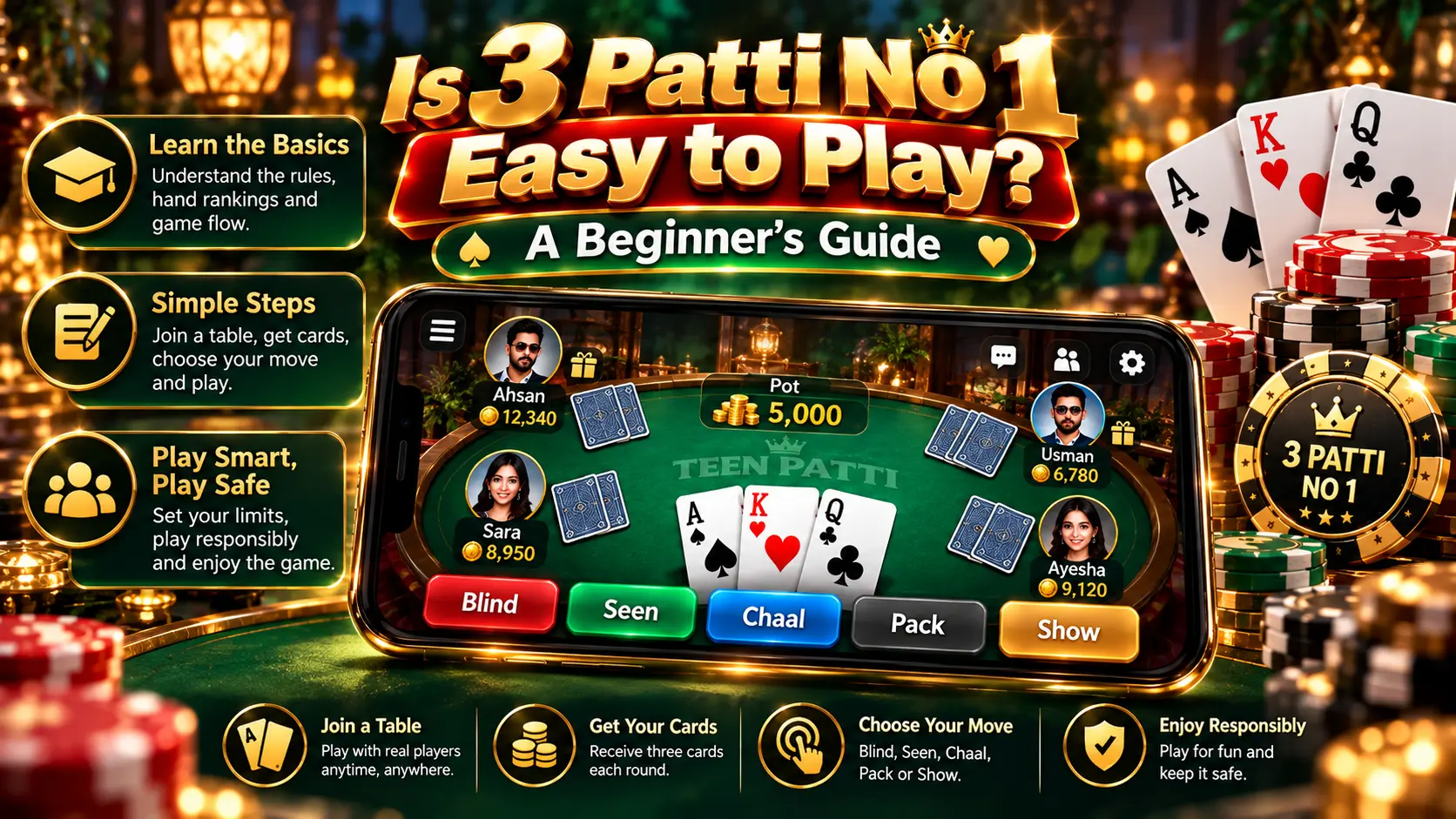
Is 3 Patti No 1 Easy to Play? A Beginner’s Guide
3 Patti No 1 Beginner Guide is a useful starting point for anyone who wants to understand Teen Patti before entering a table. The basic game is comparatively easy to learn because each player receives only three cards, but beginners still need to understand hand rankings, Blind and Seen play, betting costs, and the rules used by the specific table or app version.
Teen Patti uses a standard 52-card deck. Players contribute an initial stake, receive three cards, and then decide whether to continue or fold. Traditional rules also allow a player to remain Blind without looking at the cards or become Seen after checking them.
This 3 Patti No 1 Beginner Guide explains the basic gameplay in simple language and highlights the most important mistakes new players should avoid.
Executive summary
For a complete beginner, the mechanics of Teen Patti are simple but the betting decisions are not. Traditional Teen Patti uses a standard 52-card deck. Each player contributes an initial stake, receives three cards and can initially choose to play blind without viewing those cards or seen after looking at them. Under the traditional rules documented by Pagat, seen players generally have to stake twice as much as blind players to continue.
The six conventional hand categories, from strongest to weakest, are Trail/Trio, Pure Sequence/Straight Run, Sequence/Normal Run, Colour, Pair and High Card. An important beginner trap is that Pagat’s rules rank A-2-3 as the highest sequence, ahead of A-K-Q; individual apps and house rules can vary, so the rules screen of the table you are actually playing should prevail.
For this report, “3 Patti No1” primarily means the Google Play listing with package ID com.pattino1.apk, published by Tech Hanif. As of the research date, that listing says the app is for casual entertainment, contains advertisements, has 1K+ downloads, offers virtual rewards and does not offer real-money gambling or cash prizes. It was last shown as updated on 31 May 2026.
That qualification matters. Web searches also surface several APK websites using very similar “3 Patti No 1” branding; at least one separate promotional site describes deposits, withdrawals, tournaments and real-money earning. Those claims directly conflict with the current Google Play listing. They should therefore not be assumed to describe the same app, build or operator.
From a security perspective, the current Play listing deserves scrutiny rather than blind trust. Its developer-declared Data Safety section says device or other IDs may be shared with third parties, says “No data collected”, and also says data is not encrypted. The linked privacy policy, meanwhile, says the app may automatically process device information, app version, crash/diagnostic data and anonymous usage statistics, while advertising providers may process advertising IDs, device data, approximate IP-derived location and advertisement interactions. The two disclosures are not perfectly aligned, so users should review permissions and privacy information before installing or using the application.
Collage composition: the left panel represents traditional face-to-face Teen Patti with physical cards and a table; the centre panel represents online play with a mobile table and betting controls; the right panel represents app security, focusing on source verification, permissions and Google Play Protect. The panels were created separately and combined into one illustrative image.
Scope, assumptions and evidence quality
The biggest research limitation is identity ambiguity. “3 Patti No 1”, “3Patti No1” and similarly spelled names are used across Google Play and multiple independent APK/download websites. This report therefore anchors app-specific findings to the identifiable Google Play product 3patti no1 by Tech Hanif, package com.pattino1.apk, rather than assuming every website using the name belongs to the same developer.
This produces an important distinction:
| Evidence | Confidence | How it is used here |
|---|---|---|
| Pagat Teen Patti rules | High for traditional rules | Rules, rankings, blind/seen betting and show mechanics |
Google Play listing for com.pattino1.apk | High for the listed Play build | Current description, developer, ads, virtual rewards, Data Safety |
| Developer-linked privacy policy from that Play listing | Relatively high for declared privacy practices | Data/advertising disclosures |
| Google Android/Play support | High | Play Protect, permissions and purchase-security guidance |
| NHS and GamCare | High | Gambling-harm and safer-play advice |
| Other “3 Patti No 1” APK/promotional sites | Low-to-moderate for identifying this exact build | Used only to document conflicting branding/feature claims |
The Google Play listing describes its product as a virtual entertainment game, explicitly saying there is no real-money gambling, cash prize or conversion of virtual chips to real-world value. Therefore, references below to payments or real-money gambling are conditional: they concern another same-name build only if the user has independently verified that it is genuinely operated by a different provider and offers those functions lawfully in their jurisdiction.
Game basics and Teen Patti hand rankings
The underlying game is straightforward. Pagat describes Teen Patti as an Indian three-card game played with a standard international 52-card pack, with cards normally ranking from Ace high to Two low. Players agree an initial minimum stake, contribute it to the pot and receive three cards each. Betting then determines who remains in contention for the pot.
The objective is not simply “get the best three cards”. A player can also win because all opponents fold before a comparison takes place. When only one player remains, that player wins the pot irrespective of what cards they actually held.
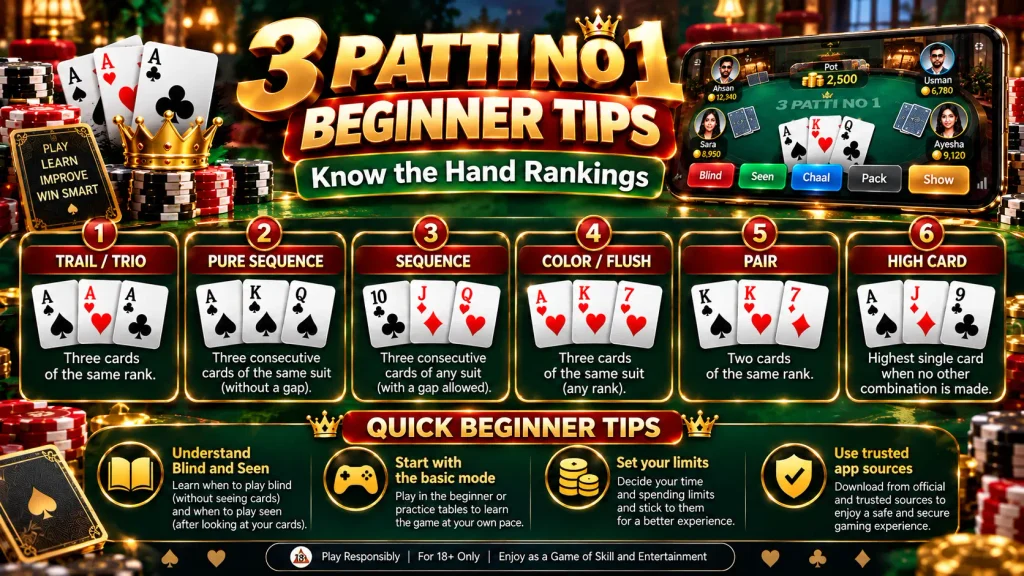
Teen Patti hand rankings
| Rank | Hand | Meaning | Example | Beginner note |
|---|---|---|---|---|
| Highest | Trail / Trio | Three cards of the same rank | A♠ A♥ A♦ | Three Aces are the highest Trail under Pagat |
| ↓ | Pure Sequence / Straight Run | Three consecutive cards, all the same suit | A♠ 2♠ 3♠ | Pagat ranks A-2-3 highest, then A-K-Q |
| ↓ | Sequence / Normal Run | Three consecutive cards, not all the same suit | A♠ 2♥ 3♦ | Beats every Colour |
| ↓ | Colour | Three cards of the same suit, not a Pure Sequence | A♣ K♣ J♣ | Compare highest, then second, then third card |
| ↓ | Pair | Two cards with the same rank | A♠ A♦ K♣ | Compare the pair first, then the odd card |
| Lowest | High Card | No combination above | A♠ K♥ J♦ | Compare highest card, then next highest |
These rankings follow Pagat’s traditional rule set. Crucially, the weakest Sequence still beats the strongest Colour, because hand category takes precedence over individual card values. Pagat also states that A-2-3 is the highest run in its version and that 2-A-K is not a valid run.
The terminology is not completely standard across every table. For example, “Pure Sequence” and “Straight Run” may refer to the same category, while “Sequence” and “Normal Run” may be used interchangeably. An app can also implement a variation rather than Pagat’s baseline rules, so beginners should treat the table’s in-app rules as authoritative for that particular game. Pagat itself documents numerous Teen Patti variations.
Beginner gameplay walkthrough
A first game becomes much easier when reduced to a small number of decisions.
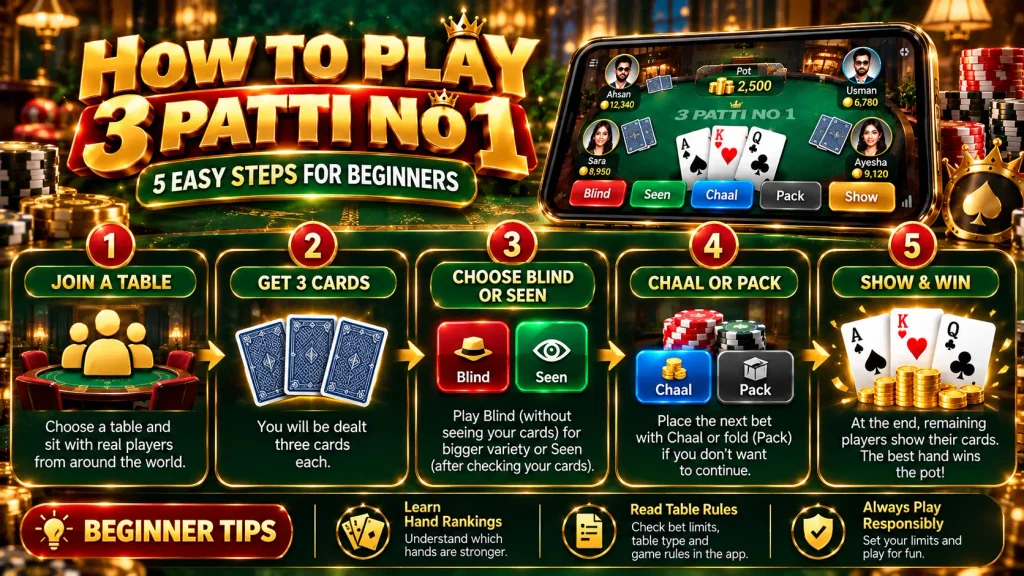
Start with the stake and deal. In traditional play, everyone contributes the agreed minimum stake before the dealer gives each player three cards. Online software normally automates the deal and pot accounting; the current 3patti no1 Play description simply instructs users to join a table, receive cards and make strategic decisions.
Decide whether to remain blind or look. A blind player has not viewed their three cards. A seen player has. A blind player may later look at the cards, but after doing so becomes seen and must follow the seen-player betting requirements.
Take your turn. Under Pagat’s traditional rules, betting proceeds clockwise. Each active player either puts more into the pot to remain in the deal or folds and forfeits whatever they have already contributed.
Understand the price difference. With a current stake of one unit, a blind player normally contributes between one and two current-stake units. A seen player normally contributes between two and four. In other words, viewing your hand gives you information but makes continuing more expensive under this traditional structure.
Suppose the current stake is 10 virtual chips. Under Pagat’s baseline betting structure, a blind player would normally be required to contribute 10–20, whereas a seen player would need 20–40. The specific amounts shown by an app can differ because variants can modify betting limits.
Fold when continuation is no longer justified. Folding ends your participation in that deal. The money or chips you already put into the pot are gone, which is why continuing merely to “recover” them is poor reasoning: those earlier stakes cannot be reclaimed simply by staying in the hand. The NHS specifically identifies trying to win back previous losses—“chasing losses”—as a warning sign when real-money gambling is involved.
Resolve the hand. Betting can finish when everyone except one player folds. If two players remain, a show can occur subject to the table’s show rules. Under Pagat’s version, a seen player cannot demand a show from a blind opponent; if both remaining players are seen, either can pay the prescribed amount for a show.
The traditional rules also include a sideshow/compromise procedure when all relevant players are seen, although this is better treated as an intermediate rule rather than something a first-time player needs to master immediately.
flowchart TD
A[Your betting turn] –> B{Have you looked at your cards?}
B –>|No – blind| C{Look now?}
C –>|No| D{Continue or fold?}
C –>|Yes| E[Become a seen player]
B –>|Yes – seen| E
D –>|Fold| Z[Leave this deal]
D –>|Continue| F[Place blind stake
normally 1x-2x current stake]
E –> G{Continue or fold?}
G –>|Fold| Z
G –>|Continue| H[Place seen stake
normally 2x-4x current stake]
F –> I{Only two players left?}
H –> I
I –>|No| J[Next player’s turn]
J –> A
I –>|Yes| K{Is a show allowed
under this table’s rules?}
K –>|No| J
K –>|Yes| L{Request/pay for show?}
L –>|No| J
L –>|Yes| M[Compare hands]
M –> N[Higher-ranked hand wins pot]
This flowchart follows Pagat’s traditional structure rather than claiming that every mobile implementation uses identical betting limits or show rules.
Common mistakes and simple beginner strategy
The most common beginner errors are rules errors rather than sophisticated strategic mistakes.
Misranking Sequence and Colour. A Sequence beats a Colour in the Pagat hierarchy. Beginners familiar with other poker-like games sometimes reverse these categories. Memorising the six hand types before playing eliminates a large class of avoidable mistakes.
Forgetting the unusual Ace rule. In Pagat’s version, A-2-3 ranks above A-K-Q in both straight-run categories, while 2-A-K does not count as a run. Because house rules can vary, check the active table’s ranking screen rather than assuming conventional poker straight rules apply.
Thinking blind means “free information”. Blind play is cheaper in the traditional betting structure, but you also have no knowledge of your own hand. Seen play gives information but normally costs more. Neither status automatically creates a winning strategy; it changes the trade-off between information and stake size.
Paying because you have already invested heavily. Money or chips already in the pot should not, by itself, justify another bet. Pagat confirms that folding sacrifices previous contributions, while the NHS warns against chasing losses in real-money gambling.
Trying advanced bluffing too soon. Hidden cards necessarily create uncertainty about opponents’ holdings, but that does not produce a simple “bluff trick” that guarantees success. For a novice, accurate hand recognition and disciplined folding are more controllable skills than attempting to predict every opponent. This is an inference from Teen Patti’s hidden-card and betting structure rather than a claim of guaranteed strategy.
A practical beginner approach is therefore:
- Learn the six rankings until recognition is instant.
- Use low-stakes or virtual-only tables while learning.
- Look at your cards early if understanding the decision is more important than experimenting with blind-play tactics.
- Treat a weak High Card as genuinely weak rather than becoming attached to an Ace alone.
- Do not increase stakes simply because you lost the previous hand.
- Stop when a pre-set time or spending limit is reached.
The final two points become especially important where actual money is involved. GamCare recommends safer-gambling tools such as limits, breaks and self-exclusion, while the NHS advises against treating gambling as a way of making money.
App experience, account setup and security
For the identifiable Google Play build, the product description emphasises an easy-to-use interface, smooth gameplay, colourful graphics, quick sessions, daily rewards/bonuses and optimisation for phones and tablets. It instructs users to join a table and compete for virtual rewards and achievements.
The following distinction is important because requested features are not all verified by the primary listing:
| Feature | Status for the researched Play build | Evidence-based interpretation |
|---|---|---|
| Tables | Confirmed | The Play listing explicitly says to “join a table” before play. |
| Virtual rewards / bonuses | Confirmed | Daily rewards/bonuses and virtual achievements are advertised. |
| Chat | Not confirmed | The current primary Play description does not document an in-game chat feature. |
| Tournaments | Not confirmed for this Play build | The Play listing does not document them. A separate same-name promotional website mentions seasonal tournaments, but its description conflicts with the Play product in other material ways. |
| In-app purchases | Not established from the primary material reviewed | The listing confirms ads and virtual rewards but does not establish a paid-chip or cash-purchase feature in the surfaced description. |
| Cash deposits / withdrawals | Explicitly denied by the researched Play build | The Play page and linked privacy policy say it does not provide real-money gambling or cash prizes. |
This means an article describing “3 Patti No 1” as simultaneously offering the Tech Hanif Google Play build and JazzCash/Easypaisa cash betting would combine evidence from apparently different products unless the operator can independently prove they are connected. One same-name promotional website claims real-money deposits and tournaments, whereas the current Play listing explicitly states that all chips and rewards are virtual.
The image above is an illustrative interface concept, not a screenshot of a verified 3 Patti No1 build. It shows the sort of table, chip counter and blind/seen/fold controls a beginner guide might explain without implying that the exact interface exists in the researched app.
Account setup. The Play listing itself does not provide enough information to establish whether an account is mandatory, whether guest play exists, or exactly which credentials an account requires. Those points should therefore be checked inside the current app rather than filled in from unrelated APK websites.
Permissions. Android allows users to review and change application permissions through Settings → Security & Privacy/Privacy → Permission Manager, with exact menu labels varying by device. Google also allows permissions for unused apps to be automatically removed or paused. A card game should not simply be given access to sensitive functions because it asks; consider whether each request—camera, microphone, contacts, files or location—has an obvious feature-related justification.
Privacy disclosures. The Google Play Data Safety section for the researched app says device or other IDs may be shared with third parties, “No data collected”, and “Data isn’t encrypted”. Its linked privacy policy separately states that device model, operating-system version, app version, language, crash/diagnostic information and anonymous usage statistics may be processed; advertising partners may also process advertising IDs and IP-derived approximate location. Because these declarations are somewhat difficult to reconcile, a cautious user should review both before installation.
Play Protect. Google says Play Protect checks Play Store applications before download, scans the device for potentially harmful applications from other sources, can warn about harmful software, and may disable or remove it. Google recommends keeping Play Protect switched on. For apps installed outside Play, its “Improve harmful app detection” option can submit unknown applications for additional analysis.
That does not mean a Play Protect scan guarantees that an app is trustworthy, fair or financially safe; it is primarily a harmful-app/security mechanism. This distinction is an inference from what Google says the service actually checks.
Payments. For the specific researched Play listing, real-money deposits and withdrawals are explicitly disclaimed. Nevertheless, users should enable Google Play purchase verification for other games that do sell digital items; Google provides password or biometric purchase-verification settings.
Never send a password, banking PIN, one-time verification code or payment credential to another player or someone claiming to offer a “winning trick”, withdrawal unlock or account upgrade. Where an app genuinely uses Google Play Billing, purchases should appear in Google Play’s payment/order systems; Google provides an order-history page under Payments & subscriptions.
Traditional Teen Patti versus 3 Patti No1 and responsible play
| Area | Traditional Teen Patti | Researched 3 Patti No1 Play app |
|---|---|---|
| Rules | Physical 52-card game; three cards each; blind/seen play; betting and show rules governed by players’ agreed variant. | Inspired by classic Teen Patti, but the Play description does not document every traditional betting rule; app implementation should be checked in-product. |
| Social interaction | Face-to-face conversation and observation are naturally possible. | Remote/mobile interaction; chat is not confirmed by the primary listing reviewed. |
| Security | No APK, app account or device permissions are required for the physical card game. | Introduces software, privacy, advertising and device-security considerations; the listing contains developer-declared Data Safety information. |
| Payments | Can be played for points, chips or an agreed stake depending on participants and local law. Pagat’s baseline description uses a monetary pot. | The specific Google Play build says its coins/rewards are virtual and cannot be exchanged for real value. |
| Learning curve | Someone must deal, track stakes and explain rules manually. | Software can automate cards and table flow; the listing promotes quick sessions and an easy interface, although strategy still requires understanding rankings and betting. |
So, is 3 Patti No 1 easy to play? At the mechanical level, yes: receiving three cards, comparing six hand categories and choosing whether to continue or fold can be learnt quickly. What requires more practice is judging when the cost of continuing is justified, remembering how blind versus seen play changes stake requirements, and recognising when the particular app’s rules differ from traditional Teen Patti.
Responsible-play safeguards matter even more where a different version of the game involves real money. The NHS says gambling-related harm can affect finances, relationships and physical or mental health, and identifies betting more than one can afford, chasing losses and borrowing to gamble as warning signs. It advises people not to view gambling as a way of making money.
GamCare provides free confidential support through the UK National Gambling Helpline and describes tools including self-exclusion. Its current information gives the helpline as 0808 8020 133, available 24 hours a day, seven days a week.
For the researched Play build, which says it is virtual-only, the practical equivalent is still useful: set a fixed session time, avoid treating virtual wins as evidence that real-money gambling would be profitable, and stop if the game is interfering with sleep, work, study, relationships or mood. The caution about real-money profitability is particularly consistent with NHS guidance not to regard gambling as a source of income.
Beginner checklist
- □ Memorise Trail → Pure Sequence → Sequence → Colour → Pair → High Card.
- □ Check whether your specific table follows the Pagat-style A-2-3-high sequence rule.
- □ Know whether you are blind or seen before pressing a betting control.
- □ Remember that switching from blind to seen changes the normal betting requirement.
- □ Learn to fold rather than continuing simply to recover chips already committed.
- □ Confirm the exact developer/package name before installing a same-name app.
- □ Review permissions and the privacy disclosure before granting sensitive access.
- □ Keep Google Play Protect enabled.
- □ Do not assume tournaments, chat or cash payments exist unless your exact build documents them.
- □ Where money is involved, decide the maximum affordable loss before starting and never chase losses.